



When markets are volatile, it is natural to feel anxious. Sharp falls are newsworthy and the instinct to do something, such as sell and move to perceived safer investments, can be strong. However, one aspect of investing is that long-term returns are driven by a surprisingly small number of days. For most of the time, markets tend to move in narrow bands.
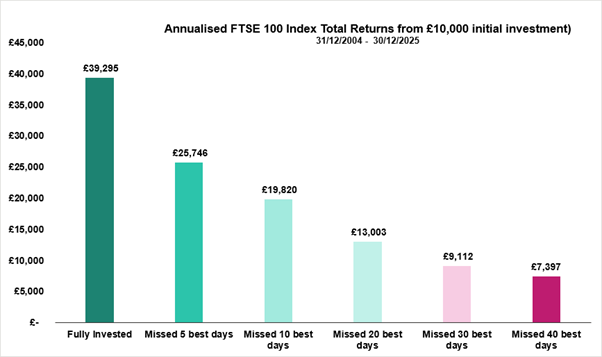
The chart below illustrates this:
Source: FactSet / 7IM. Past performance is not a guide to the future.
Over the past 20 years, the FTSE 100 has delivered an annualised return of around 6.7%. A £10,000 investment left untouched over that period would have grown to roughly £39,000. If you miss a handful of the best-performing days, the outcome can be significantly different. Miss the best five days over that 20-year period and the annualised return falls to around 4.7%. This means that £10,000 would have grown to closer to £26,000. Miss the best 30 days, one month out of 20 years, and the outcome is worse still; in this instance, the investment would have fallen in value. However, it is worth noting that many of the best days in the market happen close to the worst ones.
At Wingate, we see investing as a long-term proposition. There will be times when looking at investment values online will be uncomfortable. Past performance statistics show that those who have remained invested tend to experience better outcomes than those who are reactive to short-term market movements.
If recent market movements have made you feel uneasy, it may be worth reviewing your approach to investing and appetite for investment risk. Additionally, a personalised cash flow plan will organise your finances and help you to feel in control, particularly in volatile markets.
If you would like to revisit your approach to financial planning, get in contact.
Footnote / assumptions
The figures shown are illustrative and based on a £10,000 investment held over 20 years, assuming a constant annualised return of 6.7%, with no additional contributions or withdrawals. Returns are shown gross of inflation and before any charges, taxes or platform fees. Actual returns will vary depending on timing, costs, dividends, taxation and individual circumstances. Past performance is not a reliable indicator of future returns.